Cooling Comfort for Nursing: How Cold Cryogels Help Skin Feel Soothed

Somewhere between the third feeding of the day and the fourth, breasts can start to feel full, tight, and hard to ignore. That is usually the moment new moms start searching for a cold pack for breastfeeding: something simple to reach for between feeds that actually helps skin feel calmer. The good news is that a cold pack is one of the simplest, most well-established comfort tools in a nursing routine. It does not require a prescription, a pharmacy run, or any guesswork.
Why Cold Feels So Good on Full, Tender-Feeling Nursing Skin
Nursing skin works hard. Milk production changes the tissue underneath the surface hour to hour. By the end of a long stretch between feeds, skin across the chest can feel tight, heavy, and overly warm to the touch. Cold changes that sensation almost immediately.
Cool temperatures naturally narrow the blood vessels near the surface of the skin. That is part of why a chilled compress feels calming on tight, full-feeling skin. The coolness itself is soothing, and it gives overstimulated nerves something gentler to register than heat and pressure. You do not need a lab report to notice the difference: most moms feel it within a minute or two.
It is the same instinct behind pressing something cool against tired, puffy-looking eyes after a rough night. Cold calms the surface fast, and it works just as well on tender-feeling nursing skin as anywhere else on the body.
For a lot of new moms, the full, tight feeling shows up at predictable moments. It might be early in the morning, mid-afternoon after a long stretch between feeds, or in the middle of the night when everything already feels harder. A cold pack will not change a sleep schedule, but it can make the skin part of those moments feel more manageable in a minute or two.
Cold vs. Warm: When Each One Actually Helps
Cold and warm both have a place in a nursing routine, but they solve different problems.
Warmth relaxes tissue and can make it easier for milk to flow, which is why a warm shower or warm cloth before feeding is such a common ritual. Cold works differently. It does not get milk moving. It calms the skin and eases that tight, overfull feeling once a feeding is done.
The American Academy of Pediatrics' HealthyChildren.org draws a simple line: warmth before a feed helps things get going, and something cool between feeds brings comfort. That timing matters more than which specific cold source is on hand.
How to Use a Cold Pack for Breastfeeding Comfortably and Safely
A cold pack works best, and feels best, when it is used the right way.
- Add a cloth barrier. Always put a layer between the cold pack and skin. A thin towel, a muslin cloth, or a clean t-shirt all work well. Skin on the chest is delicate, and direct ice-cold contact can feel harsh instead of soothing.
- Keep sessions short. Most guidance points to roughly fifteen to twenty minutes at a time, not longer.
- Take breaks between applications. La Leche League International, a global lactation support organization, suggests alternating twenty minutes of cold with twenty minutes off. Short breaks tend to feel more effective than one long, steady chill.
- Use it between feedings, not during. Cold narrows blood flow at the surface, so it fits better into the calm, in-between moments of the day than the feeding itself.
- Pair it with loose, breathable layers. A snug bra or tight top adds pressure on top of skin that already feels full. Loose clothing between sessions lets a cold pack do its work without extra pressure fighting against it.
None of this needs to be complicated. A clean, cloth-wrapped cold pack pressed gently to the skin for a few minutes still works. It is one of the most effective comfort habits a nursing mom can build into her day.
The Case for Reusable, No-Refrigeration Cooling
Bags of frozen peas and towel-wrapped ice cubes work well enough. They are also inconvenient. They leak as they thaw, they take up freezer space, and they are rarely on hand at 2 a.m. when they are actually needed.
That is the appeal of a purpose-built, reusable cooling pad. Something designed to stay flexible and skin-conforming, ready in a bag or on a nightstand without a freezer in sight, fits into a nursing routine differently. An ice-filled sandwich bag never will.
It travels well too. Dropped into a diaper bag or a hospital bag, a pad that never needs a freezer is ready the moment it is needed. That might be a middle-of-the-night feed at home or a long day out.
No clips, no straps, no mid-feed scramble to find something cold.
Where Hypochlorous Acid Water-Stable Cryogels Fit In
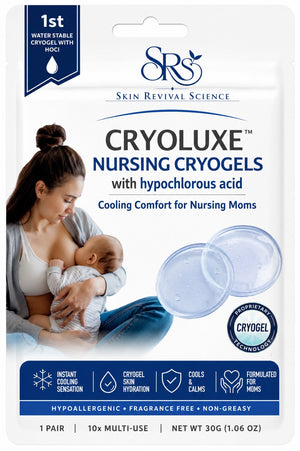
This is where Cryoluxe's Nursing Cryogels come in. Cryoluxe calls its technology the 1st water-stable cryogel with Hypochlorous Acid (Hypochlorous Acid), the same molecule the body's white blood cells naturally produce. Most actives like Hypochlorous Acid break down quickly in water, but Cryoluxe's proprietary cryogel matrix holds it stable, so the pad stays cool and consistent every time it is used.
Nursing Cryogels are designed to conform gently to the skin, with no clips, straps, or sticky residue. Each pad can be reused up to 10 times. Open it, apply it, relax for five to twenty minutes, then rinse with cool water and return it to its resealable pouch. No refrigeration is required, though many moms like to chill the pouch ahead of time for an extra-cool feel. Cooling comfort starts on contact, which is really the whole idea: something simple, ready, and calming for skin that has had a long day.
Cryoluxe products are cosmetics, designed to cool, comfort, hydrate, and support the look and feel of healthy skin. They are not intended to diagnose, treat, cure, or prevent any condition.
Making Cooling Comfort Part of Your Routine
A cold pack for breastfeeding does not need to be complicated. Keep one within reach, protect skin with a cloth barrier, and take a few quiet minutes whenever things feel full or tight. Whether that is a towel-wrapped bag from the freezer or a reusable cryogel pad built for the job, the goal is skin that feels calmer, faster.
For moms who want something designed for this stage, Cryoluxe's Nursing Cryogels offer cooling comfort in a reusable, no-refrigeration-needed pad, ready whenever nursing skin needs a moment to settle.
Frequently Asked Questions
Is a cold or warm compress better for full, tender-feeling breasts while nursing?
Cold generally feels better for fullness and tightness between feedings, while warmth helps right before a feeding session. Try a warm cloth or shower before nursing, then switch to a cool compress afterward. Many moms alternate both, using whichever feels calming in the moment.
How long should I leave a cold pack on while breastfeeding?
Most guidance suggests fifteen to twenty minutes per session, with a cloth layer between the pack and skin. Longer is not better: extended cold exposure can feel uncomfortable rather than soothing. Short breaks between applications tend to feel more effective than one long, continuous chill.
Can I use a bag of frozen vegetables instead of a dedicated cold pack?
Yes, a towel-wrapped bag of frozen peas or corn works in a pinch and molds well to the chest. The tradeoff is convenience: it needs freezer space, it can leak as it thaws, and it is not always on hand. A reusable cooling pad solves that without the mess.
Do I need to refrigerate a reusable cooling pad like Nursing Cryogels?
No. Cryoluxe's water-stable cryogel pads work at room temperature and do not require refrigeration, though chilling them beforehand gives an extra-cool feel. That makes them easy to keep in a diaper bag, nightstand, or nursing station, ready whenever skin needs a moment of calm.