Is Glycolic Acid Safe During Pregnancy?

A positive pregnancy test tends to send people straight to their bathroom shelf, reading ingredient labels they never used to think twice about. Glycolic acid is one of the first names that comes up, since it sits in half the cleansers, toners, and serums out there. So is glycolic acid safe during pregnancy? The short answer from most dermatology sources is reassuring, with a few real caveats worth understanding before you keep reaching for that bottle.
A quick note before diving in: this is general education, not medical advice for your specific pregnancy. Every pregnancy is different, so loop in your OB, midwife, or dermatologist before adding or continuing any active ingredient in your routine, especially in the first trimester.
What Glycolic Acid Actually Is
Glycolic acid is an alpha hydroxy acid, usually derived from sugarcane, and it is one of the most common exfoliating ingredients in skincare. It works on the surface of the skin, loosening the bonds between dead skin cells so they shed more easily. That is why it shows up in cleansers, toners, serums, and the occasional in-office peel, promising smoother texture and a more even-looking tone.
Because it is so common, most people already have at least one glycolic acid product in their routine long before a positive test shows up. That is exactly why the question comes up so often once a pregnancy begins.
Is Glycolic Acid Safe During Pregnancy? What the Research Says
A review of skin care product safety in pregnancy, published in Canadian Family Physician, found that no studies have tested topical glycolic acid directly in pregnant women. That gap sounds worse than it is. The same review noted that topical glycolic acid should not be a significant concern. Only a small amount is expected to reach the bloodstream when it is applied to the skin's surface.
Absorption through skin depends on a few things: the concentration of the product, its pH, and how long it sits on the skin. In lab studies, absorption ranged from close to nothing up to around a quarter of what was applied, with higher concentrations and longer contact time pushing that number up. That is one reason dermatology sources tend to draw a line. A daily cleanser or serum under about 10 percent glycolic acid is generally considered a lower-risk choice, separate from a stronger in-office option.
There is one caveat worth knowing. Older animal studies did find effects at very high doses, far above what is in a bottle of face wash. Those findings are part of why the guidance stays cautious, and why asking your provider first is not just a throwaway line here.
Where the Caution Comes From: Peels and Higher Concentrations
Chemical peels are where most of the more careful guidance lives. A professional glycolic acid peel uses a much higher concentration than anything in a drugstore bottle. It often sits on the skin longer too, sometimes on skin that has already been exfoliated or has a compromised barrier. All of that adds up to more absorption than a quick swipe of toner.
This is also where the difference between a home routine and an in-office visit really matters. A low-percentage, wash-off or leave-on product used a few times a week is a very different exposure than a professional-strength peel. Many pregnant patients choose to pause in-office peels and stronger options for now, keeping a lower-concentration product in the daily routine after checking with their provider.
Safer Ways to Use Glycolic Acid During Pregnancy
A few habits make it easier to use glycolic acid thoughtfully while pregnant:
- Check the concentration. Many dermatology sources point to products under about 10 percent as the more commonly discussed range for pregnancy, rather than anything stronger.
- Skip professional peels for now. Save stronger, in-office glycolic acid work for after pregnancy and breastfeeding, when you and your provider can revisit it together.
- Patch test first. Pregnancy hormones can change how skin reacts, so even a product you have used for years is worth a small test spot before a full application.
- Watch what you pair it with. Layering glycolic acid with retinoids is where the bigger question marks show up. Most dermatology guidance is far more direct about retinoids. Groups like the American Academy of Dermatology note that experts generally recommend stopping tretinoin during pregnancy, since oral retinoids are linked to birth defects.
- Tell your provider what is in your routine. A quick rundown of your skincare at a prenatal visit takes two minutes and gives you a clear answer specific to you, not a general one from the internet.
Building a Gentle Pregnancy Skin Routine
Skin during pregnancy does not always behave the way it used to. Hormones shift oil production, sensitivity, and even how a familiar product feels going on. A lot of people use this stretch as a reason to simplify: fewer steps, gentler formulas, less guesswork.
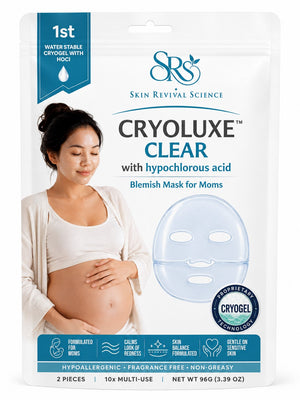
If you are paring down while you sort out which actives to keep, gentle and fragrance-free is a reasonable default across the board. Cryoluxe's water-stable Hypochlorous Acid cryogels, including the Cryoluxe Clear mask for breakout-prone skin, do not contain glycolic acid or any other exfoliating acid. They are a different category of product, built around cooling comfort and gentle hydration rather than exfoliation. Think of it as a calm addition to a pregnancy-friendly routine, not a swap for an AHA.
Cryoluxe products are cosmetics, designed to cool, comfort, hydrate, and support the look and feel of healthy skin. They are not intended to diagnose, treat, cure, or prevent any condition.
When to Loop In Your OB or Dermatologist
A few situations are worth a direct conversation instead of guesswork. That includes being in your first trimester, noticing your skin has become more reactive, or already using a prescription-strength acid or retinoid. In any of those cases, bring your full routine to your next visit.
Your OB, midwife, or dermatologist can look at what you are actually using, at what strength, and how often. From there, they can give you guidance built around your own pregnancy, not a general internet answer. That conversation is quick, and it is the most reliable way to feel confident about what stays in your routine and what waits until after delivery.
Glycolic acid is one of the more forgiving actives to navigate during pregnancy, especially in the low concentrations found in everyday cleansers and serums. Keep the strength modest, skip the professional peels for a few months, and let your provider have the final say. The rest of your routine can stay simple: gentle, fragrance-free, and built for skin that is doing a lot of work right now.
Frequently Asked Questions
What skincare ingredients should I avoid during pregnancy?
The clearest ingredient to avoid is topical retinoids, including tretinoin and adapalene, since oral versions are linked to birth defects and experts recommend stopping them during pregnancy. High-dose salicylic acid, hydroquinone, and certain essential oils also come up often. Glycolic acid in low concentrations is generally viewed differently and considered lower risk.
Is a 7 percent glycolic acid product safe to use during pregnancy?
Seven percent is on the lower end of glycolic acid strengths, below the roughly 10 percent threshold many dermatology sources point to as a reasonable ceiling during pregnancy. That does not make it automatically fine for everyone. Mention the specific product and strength to your OB or dermatologist before adding it to your routine.
What face acids are safe to use during pregnancy?
Azelaic acid and low-concentration glycolic acid are the two that come up most often in dermatology guidance for pregnancy, along with limited salicylic acid use. Lactic acid, a gentler AHA, is generally grouped with glycolic acid as a lower-risk option. Concentration and frequency of use matter more than the acid's name.
Is it safe to get a glycolic acid peel while pregnant?
Most dermatology guidance leans cautious on peels specifically. Professional glycolic acid peels use much higher concentrations and longer contact time than a daily cleanser or serum, which likely increases how much is absorbed. Many providers suggest pausing stronger in-office peels during pregnancy and revisiting them afterward.