Gentle Cleansers for Pregnancy: What to Look For

If you typed "safe cleanser for pregnancy" into a search bar at some point this week, you're in good company. Pregnancy has a way of turning routine questions into researched ones, and your daily face wash is no exception. The reassuring news is that choosing a gentle, pregnancy-friendly cleanser mostly comes down to a few clear, learnable habits, not a minefield of ingredients to fear.
A quick note before we get into it: this is general education, not medical advice for your specific pregnancy. Every pregnancy is different, so check with your OB, midwife, or dermatologist before changing your skincare routine, especially in the first trimester.
What "Gentle" Actually Means for a Cleanser
"Gentle" isn't just marketing language. It describes a few real, checkable properties. Look for these three things on the label and in how the product feels on your skin.
- Non-stripping surfactants. Harsh sulfates can strip natural oils along with dirt and makeup, leaving skin tight and reactive. Milder surfactant systems clean just as well without that tug.
- Fragrance-free. Added fragrance is one of the more common irritants in skincare, and pregnancy hormones can turn a scent you used to love into one that stings or overwhelms you.
- A skin-respecting pH. Healthy skin sits at a mildly acidic pH, close to 5.5. Dermatology research on cleanser formulation has found that products closer to that range tend to leave the skin barrier calmer than high-pH, heavily foaming soaps.
A cleanser that checks all three tends to leave your face feeling clean but not squeaky or tight. That tight feeling is usually a sign the barrier just took a hit, not a sign the product worked extra well.
Which Cleanser Ingredients to Skip or Discuss During Pregnancy
Most of what sits in a rinse-off cleanser has limited time to interact with your skin before it goes down the drain. That timing matters for how much of anything actually gets absorbed. Still, a couple of active ingredients are worth knowing about by name.
Salicylic acid shows up in a lot of blemish washes. The American Academy of Dermatology notes that salicylic acid is generally considered fine to use for a limited time during pregnancy. They still recommend looping in your OB or dermatologist before starting one. A peer-reviewed review of skin care product safety in pregnancy looked at absorption directly. How much salicylic acid reaches the bloodstream depends on the product's vehicle, strength, pH, and where it's applied. That's one reason a daily low-concentration wash is a different conversation than a stronger leave-on serum or an in-office option.
Retinoid-containing cleansers are the clearer one to set aside. That same review documented case reports linking topical tretinoin to birth defects, and while larger studies haven't confirmed the risk, dermatology groups broadly recommend stopping topical retinoids during pregnancy. If a cleanser lists retinol, retinyl palmitate, or tretinoin on the label, save it for after you deliver.
Exfoliating acid cleansers built around glycolic or lactic acid fall into a more reassuring category. We've written a full breakdown of glycolic acid and pregnancy if you want the details on concentration limits and why peels are viewed differently than a daily wash.
How to Read a Cleanser Label Like a Pro
There's no official approved list of pregnancy-friendly skincare brands, and any site that hands you one is guessing. What actually helps is knowing how to read an ingredient list yourself.
Start with the first five ingredients, since they typically make up most of the formula. Scan for retinol, retinyl palmitate, or tretinoin, and set those aside. Note the salicylic acid percentage if the label lists one, since that's the detail worth mentioning to your provider. Favor "fragrance-free" over "unscented," since unscented products can still contain a masking fragrance to cover other ingredient smells.
A brand that lists its full ingredients clearly, avoids vague marketing language, and keeps formulas simple is usually easier to evaluate than one that doesn't. That habit is a more useful filter than chasing a badge that promises perfect safety, since cosmetic labeling isn't independently regulated the way marketing claims can suggest.
Building a Simple, Gentle Cleansing Routine
A basic routine works better than a complicated one, especially while your skin adjusts to new hormones. Cleanse twice a day, once in the morning and once before bed, using lukewarm rather than hot water. Hot water can add to the stripped, tight feeling that already comes with a barrier under stress.
Use your fingertips instead of a rough washcloth or scrub brush, and keep the whole cleanse under a minute. Pat your skin dry rather than rubbing it, then follow with a fragrance-free moisturizer while skin is still slightly damp. That order helps lock in hydration instead of starting from dry skin.
If Your Skin Gets Drier or More Sensitive During Pregnancy
Pregnancy hormones can turn a cleanser you've used for years into one that suddenly stings or leaves skin feeling tight. If that happens, drop to once-daily cleansing at night, pause anything with active ingredients for a week or two, and add a simple, fragrance-free moisturizer morning and night.
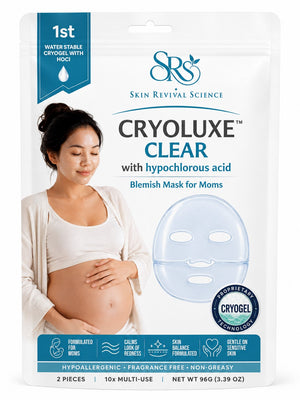
A gentle routine doesn't have to stop at cleansing. Cryoluxe's water-stable Hypochlorous Acid cryogels are fragrance-free and formulated for sensitive skin. That makes them a calm option to pair with a simplified cleansing step during an especially reactive stretch. Cryoluxe products are cosmetics, designed to cool, comfort, hydrate, and support the look and feel of healthy skin. They are not intended to diagnose, treat, cure, or prevent any condition.
When to Loop In Your OB or Dermatologist
A few situations are worth a direct conversation instead of guesswork. That includes being in your first trimester, or already using a prescription-strength acid or retinoid. It also includes noticing your skin has become unusually reactive to a product you've used safely for years.
Bring your cleanser, and anything else in your routine, to your next visit. Your OB, midwife, or dermatologist can give you guidance built around your specific pregnancy, not a general answer pulled from a search result.
Choosing a gentle cleanser for pregnancy comes down to a short list. Non-stripping surfactants, fragrance-free formulas, a skin-respecting pH, and a clear-eyed look at a couple of specific actives. Keep your routine simple, ask your provider when a specific product gives you pause, and let the rest of your skincare stay easy while your body does the harder work.
Frequently Asked Questions
What facial cleansers are safe to use during pregnancy?
Most rinse-off facial cleansers are considered fine during pregnancy, especially fragrance-free formulas built on mild, non-stripping surfactants. The ingredients worth flagging for your provider are higher-strength salicylic acid washes and anything listing a retinoid. When unsure, bring the ingredient list to your OB or dermatologist.
How do I tell if a skincare brand is pregnancy-friendly?
There's no official certification for a pregnancy-friendly skincare brand, so the ingredient list matters more than the name on the bottle. Check for fragrance-free formulas, skip anything listing a retinoid, and note the salicylic acid percentage if one appears. That gives you something concrete to discuss with your provider.
How often should I cleanse my face during pregnancy?
Twice a day is typically enough: once in the morning and once before bed. If your skin becomes drier or more reactive as pregnancy progresses, dropping to once-daily cleansing at night usually helps. Adding a fragrance-free moisturizer helps more than switching products repeatedly.
What should I do if my skin gets drier or more sensitive during pregnancy?
Simplify first. Pause exfoliating acids or other actives for a week or two, cleanse once a day instead of twice, and apply a fragrance-free moisturizer while skin is still damp. If sensitivity continues or feels severe, mention it to your OB or dermatologist at your next visit.